The Last Week of December: A Roster Check for Clinic Owners
Ask a hospital administrator about the last week of December and the first answer is usually about doctors. Who is on leave, who is on call, who has agreed to cover the outpatient clinic on the 27th. That list is normally settled early, because it has to be. Patients ask about it.
The harder list is the one nobody circulates. Who is at the front desk on the 26th? Who opens the lab counter on the 29th? Who is in the pharmacy, and who calls the patient whose follow-up falls on the 30th? Those roles get settled late, often in the last few days, and often by a quick conversation in a corridor.
This article is a short check for owners and administrators. It takes about an hour, and it is best done before 1 December.
Why the last week is different
For most of the year, a clinic runs on habit. Everyone knows who sits where, and a missing person is covered informally by whoever is nearby. That works because absences are small and scattered.
The last week of December breaks that habit. Many staff members take leave at the same time, schools are closed, travel plans are fixed, and the people who stay are often covering unfamiliar roles. At the same time, patients still arrive, reports still need to be collected, and follow-ups still fall due. The work does not take the week off.
The risk is rarely a dramatic one. It is small gaps: a desk that opens late, a lab counter with no one who knows the collection process, a list of follow-up calls that nobody owns. Each gap is minor. Together, they are what patients remember when they decide whether to come back.
Think in roles, not names
The first step is to stop thinking about people and start thinking about roles. Write down every function that must be covered on each day of the week. For most clinics the list looks something like this:
- Front desk and registration
- Lab or sample collection counter
- Pharmacy
- Follow-up calls and reminders
- Records and billing
Doctors are on a separate list, and you already have that. This list is for everyone else.
Then ask the blunt question for each cell: who is there? Not who is usually there, but who has said yes. A name in a cell is a commitment. An empty cell is a decision you have not made yet.
Use the grid
The easiest way to do this is on a single sheet. Roles go down the side, days go across the top, from 25 December to 1 January. Print it and fill it in by hand, or put it in a shared sheet. What matters is that there is one page that everyone can see.
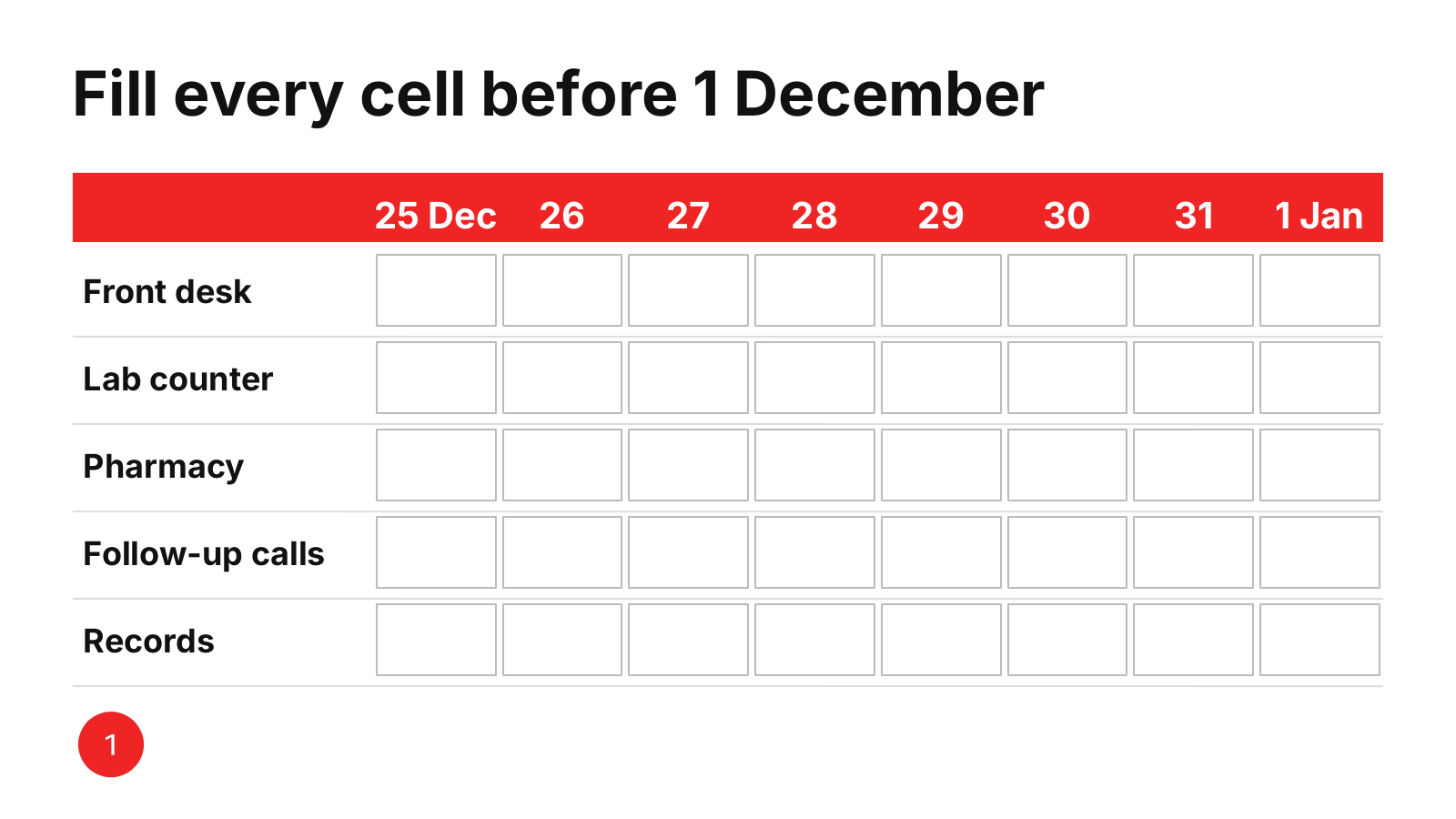
When the grid is complete, read it once as a patient would. Is there a day with only one person at the desk? A day when the lab counter depends on someone who is also covering the pharmacy? Mark those, and talk to the people involved while there is still time to change the plan.
Give follow-ups one owner
Follow-ups deserve special attention, because they are the first thing to slip. A patient who was told to come back in two weeks does not call to remind you. If nobody is watching the list, the visit simply does not happen.
Pick one person to own the follow-up list for the whole week. Not a team, one name. Their job is simple: look at who is due, make the calls, and record the outcome. If the clinic keeps its follow-up list in a diary or on one person's phone, move it to a shared place before the break starts, so that the owner and a backup can both see it.
Plan for the first days of January
The week after the break often brings its own rush. Patients who postponed a visit, follow-ups that fell due during the holidays and reports that were delayed all arrive within a few days of each other.
Before you close for the break, look at the first week of January:
- How many appointments are already booked?
- How many patients are due for follow-up but have not been contacted?
- Which staff members are back on which day?
If the first Monday looks full and the staffing looks thin, you want to know that now, not on the morning itself. A short list of patients to call in waves, spread across the week, takes pressure off the desk.
Put it in writing
The last step is the one most often skipped. Give staff the roster in writing, with enough notice to plan their own leave around it. A date like 1 December is a good target. It leaves time to fix gaps, swap shifts and confirm cover, and it saves the awkward corridor conversations on the 23rd.

If your clinic already uses a platform for appointments, records and follow-ups, such as OneHealth Digital, the roster and the follow-up list can sit in the same place as the rest of the work. If it does not, a single shared sheet is enough. What matters is that the roster exists before the week starts.
A short summary
- List every role that must be filled on each day, not only the doctors.
- Put a name in every cell, and treat an empty cell as an open decision.
- Give the follow-up list to one owner, with a named backup.
- Check how many appointments are already booked for the first days of January.
- Share the roster with staff in writing by 1 December.
None of this is difficult. It is simply easy to leave until the last week, when there is no time left to fix it.